The search for dark matter
Physics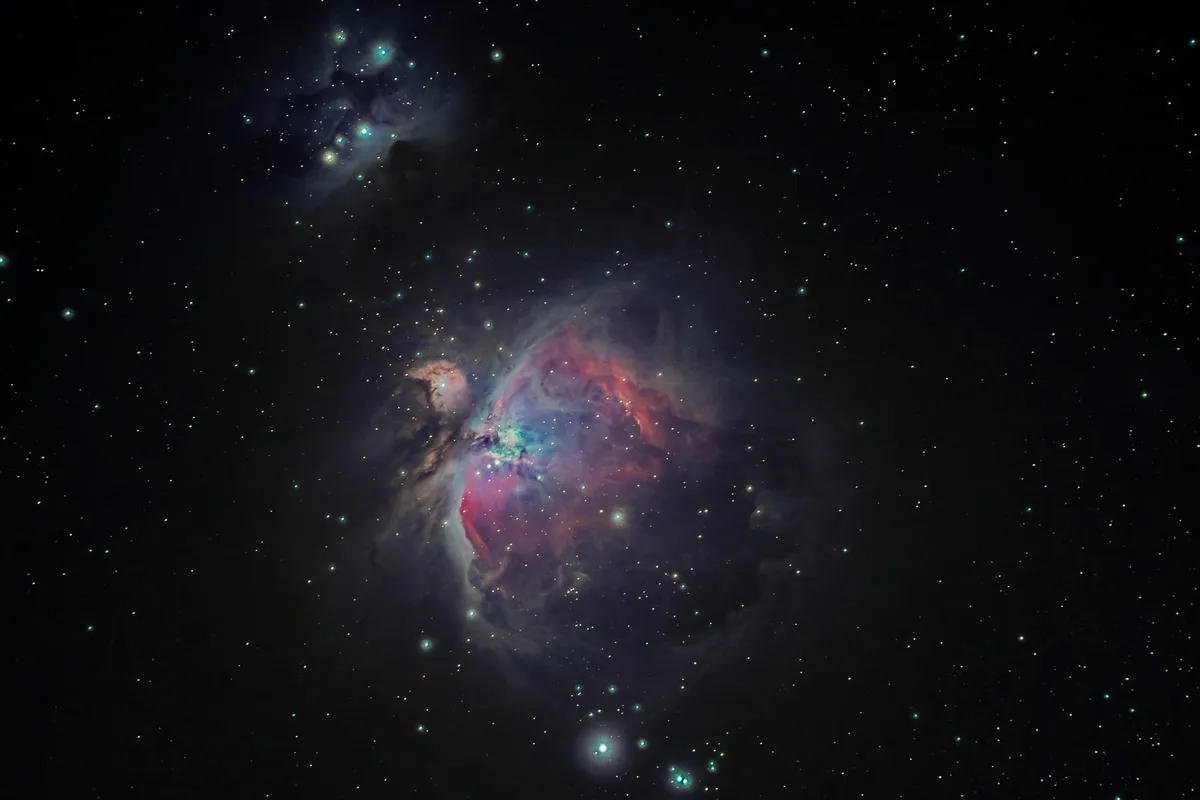
Astronomers believe most of the universe's matter is invisible. Dark matter remains one of the greatest unsolved mysteries in modern physics.
For decades, astronomers have observed a puzzling mismatch between the amount of visible matter in the universe and the gravitational effects they measure. This invisible component is known as dark matter.
When astronomers study the motion of galaxies, they find that stars move much faster than expected. Based on the amount of observable matter alone, many galaxies should fly apart. Instead, they remain stable, suggesting that a large amount of unseen mass is present.
Scientists estimate that ordinary matter—everything made of atoms—accounts for only a small fraction of the universe. The rest appears to be composed of dark matter and dark energy, two phenomena that remain poorly understood.
“The universe is not only stranger than we imagine, it is stranger than we can imagine.” — Sir Arthur Eddington
Evidence from galaxy rotation
One of the strongest pieces of evidence comes from galaxy rotation curves.
As the distance from a galaxy's center increases, stars should orbit more slowly. Observations show the opposite: orbital speeds remain nearly constant even at great distances.
This suggests the presence of an extended halo of invisible matter surrounding galaxies.
Key observations include:
- Flat galaxy rotation curves
- Gravitational lensing effects
- Large-scale structure formation
- Measurements of the cosmic microwave background
Leading dark matter candidates
Although dark matter has never been directly detected, several candidates have been proposed.
WIMPs
Weakly Interacting Massive Particles (WIMPs) were long considered one of the most promising possibilities. Numerous experiments have searched for them, but conclusive evidence remains elusive.
Axions
Axions are hypothetical particles originally proposed to solve problems in particle physics. They have become a major focus of modern dark matter research.
Primordial black holes
Some researchers have suggested that dark matter could consist of black holes formed shortly after the Big Bang. Current observations place strong constraints on this idea, but it has not been completely ruled out.
Comparison of proposed candidates
| Candidate | Type | Direct Detection Status |
|---|---|---|
| WIMPs | Massive particle | Not detected |
| Axions | Light particle | Not detected |
| Sterile Neutrinos | Neutrino-like particle | Not detected |
| Primordial Black Holes | Compact object | Under investigation |
Why it matters
Understanding dark matter would help answer some of the biggest questions in physics:
- How did galaxies form?
- What is the true composition of the universe?
- Can current theories of gravity fully explain observations?
- Is new physics required beyond the Standard Model?
Researchers around the world continue to build increasingly sensitive detectors and observatories in the hope of solving this cosmic mystery.
Looking ahead
Future experiments may finally reveal the nature of dark matter. Whether it turns out to be a new particle, a population of exotic objects, or evidence that our understanding of gravity is incomplete, the discovery would fundamentally change our picture of the universe.