What we know about black holes
Space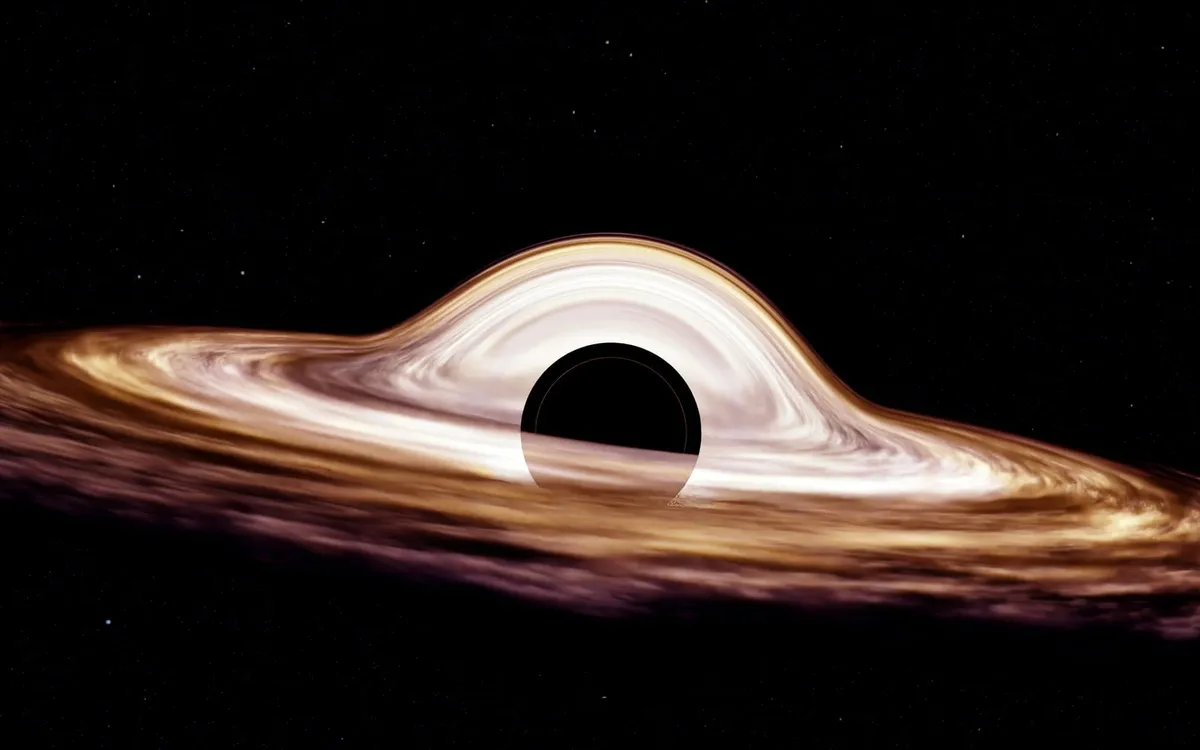
Black holes are regions of space where gravity becomes so strong that nothing, not even light, can escape once it crosses a certain boundary.
From theory to observation
Black holes were once considered a mathematical curiosity. They emerged from the equations of general relativity, which predicted that sufficiently dense matter could curve space-time to an extreme degree.
For many years, scientists had only indirect evidence for their existence. Today, observations of stars, gas clouds, and gravitational waves provide strong confirmation that black holes are common throughout the universe.
The event horizon
The defining feature of a black hole is the event horizon, a boundary beyond which escape is impossible. An observer outside the black hole can detect the effects of this boundary, but cannot see what lies beyond it.
The size of the event horizon depends on the mass of the black hole. Stellar black holes formed from collapsing stars may be only a few kilometers across, while supermassive black holes can span millions of kilometers.
Growing through mergers
Black holes can increase in mass by absorbing surrounding matter or by merging with other black holes. These collisions release enormous amounts of energy in the form of gravitational waves.
The first direct detection of gravitational waves in 2015 provided a new way to study these events and opened an entirely new field of astronomy.
The center of galaxies
Many galaxies contain a supermassive black hole at their center. The Milky Way itself hosts one known as Sagittarius A*, which contains millions of times the mass of the Sun.
Although these objects are difficult to observe directly, their gravitational influence shapes the motion of nearby stars and gas.
Unanswered questions
Despite decades of research, black holes continue to raise fundamental questions about the nature of space, time, and information. Understanding these extreme objects remains one of the most active areas of modern physics and astronomy.